
Key Takeaways
- Effective RIA practice management is a workflow-design discipline, not a tool-selection exercise. Adding more software without a connecting process can create additional friction.
- Client-count capacity models can be misleading. Preparation time per engagement can provide another useful lens on capacity because it can reflect client complexity and operational drag.
- One common workflow breakdown occurs at data intake. Manual conversion of investment statements into structured data can consume advisor time and introduce errors.
- Repeatable advice workflows from data intake to analysis to proposal can support advisor capacity, firm-wide consistency, and stronger compliance processes.
- Documented, repeatable processes can be an important consideration in succession and transition planning.
RIA practice management discussions often focus on individual decisions such as choosing a CRM, selecting a rebalancing tool, segmenting clients, or hiring an associate. That guidance can be useful, but it can also miss the underlying structural issue. Firms following this kind of approach may still find that advisors spend substantial time on meeting preparation, client deliverables vary across the team, and the path from data intake to client presentation feels operationally fragmented.
The disconnect happens because practice management is not a collection of best practices bolted together. It is a workflow-design discipline. Making the work behind advice more repeatable can help firms create capacity without relying solely on additional headcount. A technology stack is still just a list of subscriptions, while a workflow is the sequence of work that turns raw data into client-ready output.
This article examines where conventional practice management assumptions may fall short for growing firms. We will explore why processes break down at specific growth stages, how outdated capacity models mask the real bottlenecks, and what a workflow-first approach to financial advisor practice management actually looks like in practice.
Where Practice Management Can Become More Complex as Firms Grow
Practice management content often focuses on two audiences, solo advisors launching a firm or large enterprises optimizing at scale. This leaves a significant gap for firms in the messy middle, those with growing AUM, a handful of advisors, and processes that may have worked at an earlier stage but are becoming more difficult to manage consistently.
Consider an illustrative scenario common at growing firms. A firm managing several hundred million dollars across a handful of advisors may find that each advisor has built a different process for preparing annual review meetings. One might use a spreadsheet to consolidate holdings data before importing it into the planning tool; another might pull reports directly from the custodian portal and annotate them by hand; a third might rely on a paraplanner with a personal filing system. The firm may have purchased the same CRM, planning software, and portfolio accounting platform for all advisors, but the actual sequence of work has never been documented or standardized.
The result could be difficulty covering for one another across advisors, longer onboarding for new team members, and limited operational visibility into whether client deliverables meet a consistent standard.
This is the stage where a firm may feel too large for ad hoc processes but still too small to justify a dedicated COO or a six-figure technology overhaul. It is often where practice management either becomes a more deliberate discipline or settles into a patchwork of workarounds that can weigh on capacity utilization. The problem is not a lack of effort or a failure to buy tools. It is the absence of a designed, repeatable system for executing the core work of the firm.
Where Client-Count Capacity Models Can Fall Short
One common view in wealth management practice management is that growing firms should monitor client-to-advisor ratios and use them as one input into hiring decisions. That framing may not capture the full operational picture. It treats all client relationships as equivalent units of work, when in reality their operational burden is often shaped by complexity, not by headcount alone. A firm with 60 clients averaging four accounts each across multiple custodians with complex portfolios has a very different operational load than a firm with 100 clients in simple IRA rollovers.
This is why simple client-to-advisor ratio benchmarks can be misleading. A client with a single managed account and a client with a multi-custodian household containing concentrated stock and trust accounts can require very different amounts of preparation time per review.
What Complexity-Weighted Capacity Actually Measures
Another way firms can evaluate capacity is preparation time per engagement, meaning how long it takes an advisor or their team to go from raw client data to a client-ready deliverable. This metric can help surface the operational cost of a relationship. The variables that influence this burden may include the number of accounts and custodians per household, the depth of tax and fee analysis required, and whether the firm produces standardized or custom proposals.
Tracking preparation time can help firms identify whether certain complex households require a disproportionate share of advisor and operations capacity. That insight can help leadership connect operational load with profitability, looking beyond AUM to evaluate revenue per relationship. It shifts the focus from "How many clients can we serve?" to "How much complexity can our current workflow support efficiently?"
How Preparation Bottlenecks Mask as Capacity Problems
Firms sometimes interpret slow throughput as a hiring problem when it may actually be a preparation-workflow problem. When a firm's prospect conversion process requires substantial manual preparation per meeting, the constraint on growth may be less about advisor headcount than about the operational cost of producing each analysis and proposal. This is precisely the kind of bottleneck that platforms like VRGL are designed to help address by turning fragmented data intake and portfolio comparison into a structured, repeatable sequence.
An illustrative example might involve an advisor spending significant time assembling a prospect proposal, pulling statements, manually entering holdings, running analytics in one system, and building a presentation in another. That can be contrasted with a more connected workflow, where data extraction, analysis assembly, and proposal formatting are more structured and require fewer manual handoffs. The point is not a specific time reduction. It is that preparation time can meaningfully shape advisor capacity, and reducing manual steps between data intake and deliverable output can help firms create more room for client and prospect work.
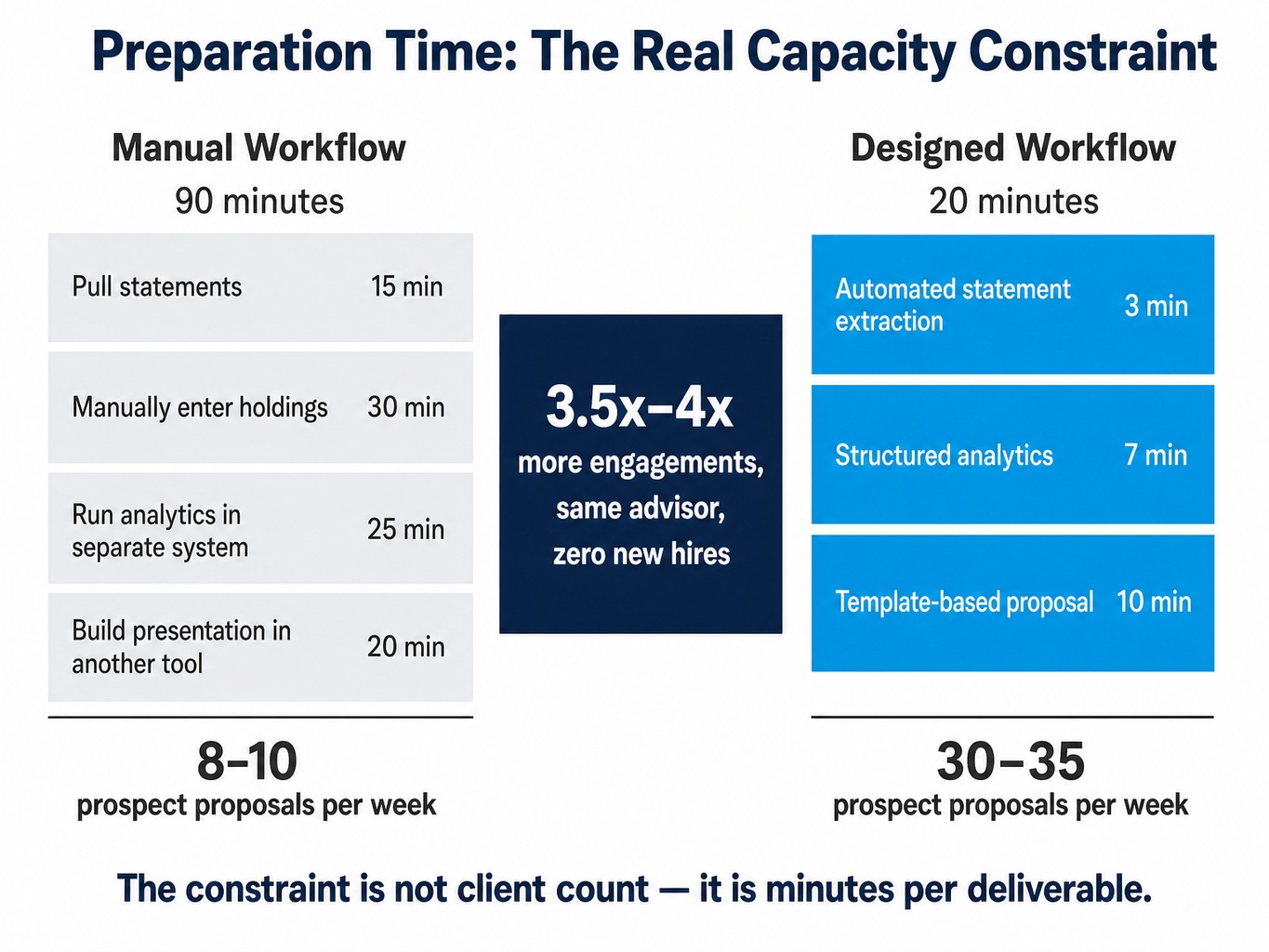
Workflow efficiency can help firms create capacity as they scale.
Read more: How to Scale a Financial Advice Practice: 6 Steps to Compound Capacity Without Burning Out
The Hidden Cost of Technology Without Workflow Design
Many RIAs have added technology over time, such as a CRM, a portfolio accounting system, a financial planning tool, and a risk tolerance questionnaire, yet manual work can still remain if those workflows are not connected. The problem is not necessarily the tools themselves but the absence of a designed workflow connecting them. The distinction between a technology stack and a workflow is critical: a stack describes what tools a firm owns, while a workflow describes the sequence and handoffs that connect those tools into a repeatable process.
Each new tool may solve a point problem but can also introduce another handoff. Data enters the CRM but must be re-entered into the analytics platform; risk scores live in one system while proposals are built in another. In some firms, operations teams may maintain a master spreadsheet just to track which data lives in which system and what manual steps are required to move information between them. That spreadsheet is often the firm's actual workflow, maintained by institutional memory rather than by technology.
This kind of manual re-entry can introduce inefficiency and create more opportunities for inconsistent data. Technology stack consolidation is not about having fewer tools from any particular vendor. It is about designing a connected workflow where data moves from intake to insight to deliverable without repeated manual handoffs at each stage. A firm's technology problem may actually be a workflow-design problem.
What Repeatable Advice Workflows Actually Look Like
A repeatable advice workflow is a structured sequence from data intake through analysis to deliverable output that advisors across the firm can follow with greater consistency. It does not rely as heavily on the founder's personal review or an individual advisor's improvised process. This stands in contrast to the common pattern where every advisor has their own spreadsheet templates, analytics views, and presentation formats, creating variation that can be difficult for leadership to oversee.
The goal is not to dictate how advisors advise. It is to standardize the operational steps that precede and follow the advice conversation. For example, a repeatable workflow defines:
- How prospect and client data is captured and structured.
- How core analytics (performance, risk, fees, tax exposure) are assembled.
- How proposals and reviews are formatted using firm-approved templates.
- How deliverables are governed for compliance and brand consistency.
Building this system is a core RIA practice management decision, not just a technology purchase.
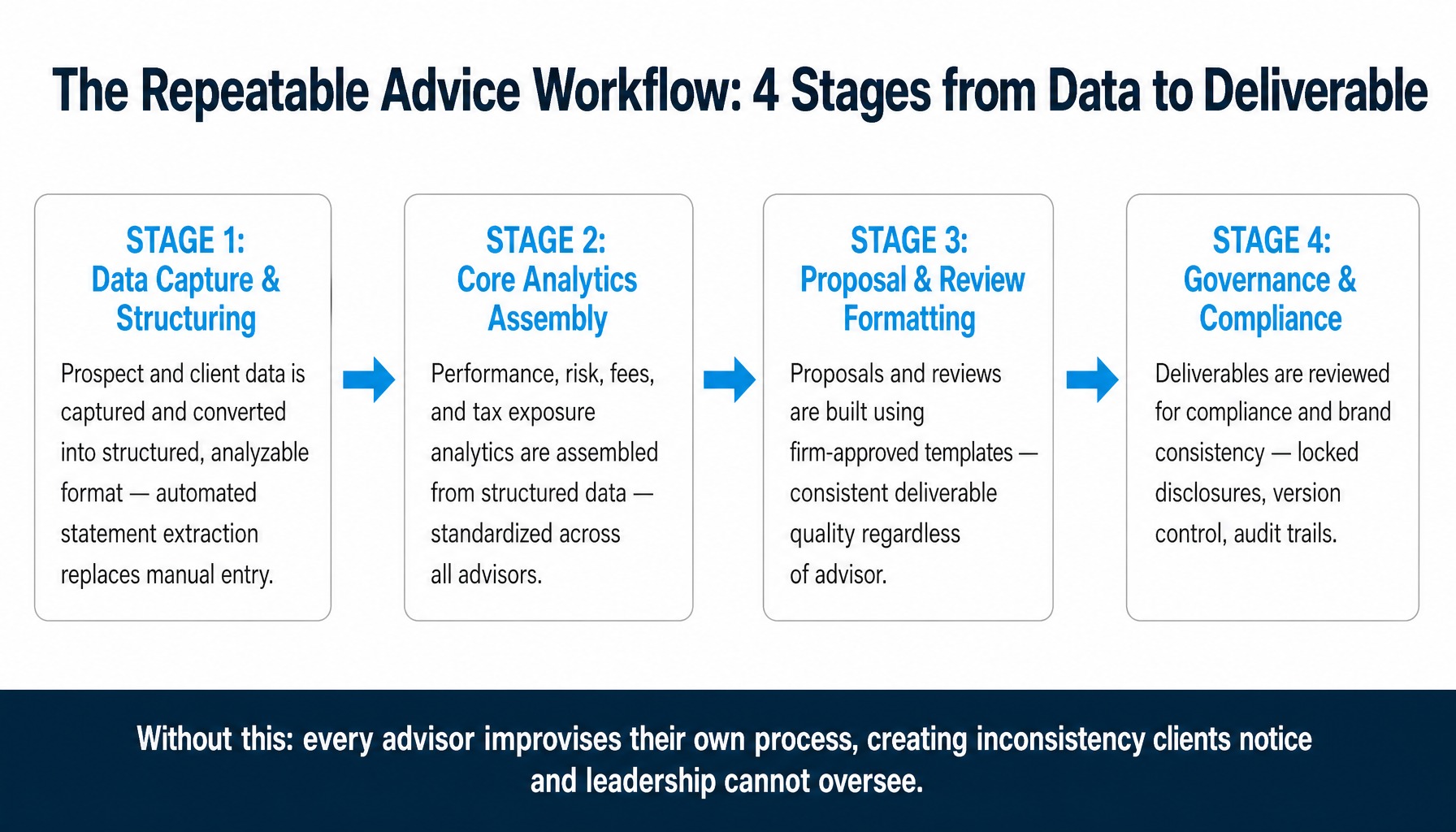
Repeatable workflows can support more scalable RIA practice management.
Where Data Intake Can Create Workflow Friction
One area where workflows can experience friction is the data-intake stage, converting prospect or client investment statements into structured, analyzable data. A typical manual process may involve an advisor or associate receiving PDF statements, manually keying holdings into a spreadsheet, and cross-referencing account details. This is often where preparation time begins to accumulate and where errors can affect the quality of the subsequent analysis.
This issue can become more noticeable in multi-custodian households, where a prospect may provide statements from several different sources, each with unique formatting. Automating this step with a platform that can extract and structure statement data can reduce manual data-entry requirements and support a more efficient preparation process.
Read more: Held-Away Assets for Financial Advisors: What Partial Data Actually Costs Your Practice
Governance Without Rigidity: How Firms Standardize Without Flattening Advisor Autonomy
When firms standardize workflows, one consideration can be how advisors will experience that change. Some teams may be concerned about preserving professional judgment or avoiding a template that feels too rigid for their client relationships. Effective governance, however, means controlling the operational scaffolding while leaving the advisory conversation to the advisor.
One approach is to provide a governed framework, firm-approved templates, required disclosures, version control, audit trails, and permission structures, within which advisors can still customize their output. Frameworks of this kind can support greater consistency in client-facing materials, regardless of which advisor or office produced them. Building compliance considerations into the workflow from the start, rather than treating them as a final gate, can also help reduce last-minute revisions when advisors build materials in formats that are not already aligned with firm standards. This is one way firms balance firm-wide consistency with advisor flexibility.
Practice Management Through the Lens of Enterprise Value
Practice management decisions can also shape a firm's operational readiness over time. A firm where the founder personally reviews every proposal, where client relationships depend heavily on individual advisor memory, and where workflows exist primarily in spreadsheets and institutional knowledge may have more key-person dependency than a firm with more documented processes. Those patterns may become relevant in succession, transition, or due diligence conversations.
From that perspective, the distinction is less about labeling one firm a practice and another a business, and more about understanding how transferable the underlying workflow really is. When core processes rely heavily on individual habits, transitions can become more complex for leadership teams to evaluate and plan around.
Contrast this with a firm where the advice workflow is documented, repeatable, and executable by trained advisors across the team. That kind of operating model can support greater consistency, reduce reliance on any single individual, and provide a clearer foundation for succession planning or operational due diligence. Building repeatable workflows is not just an efficiency consideration, it can also support a business that is less dependent on any one person during periods of leadership change, growth, or transition.
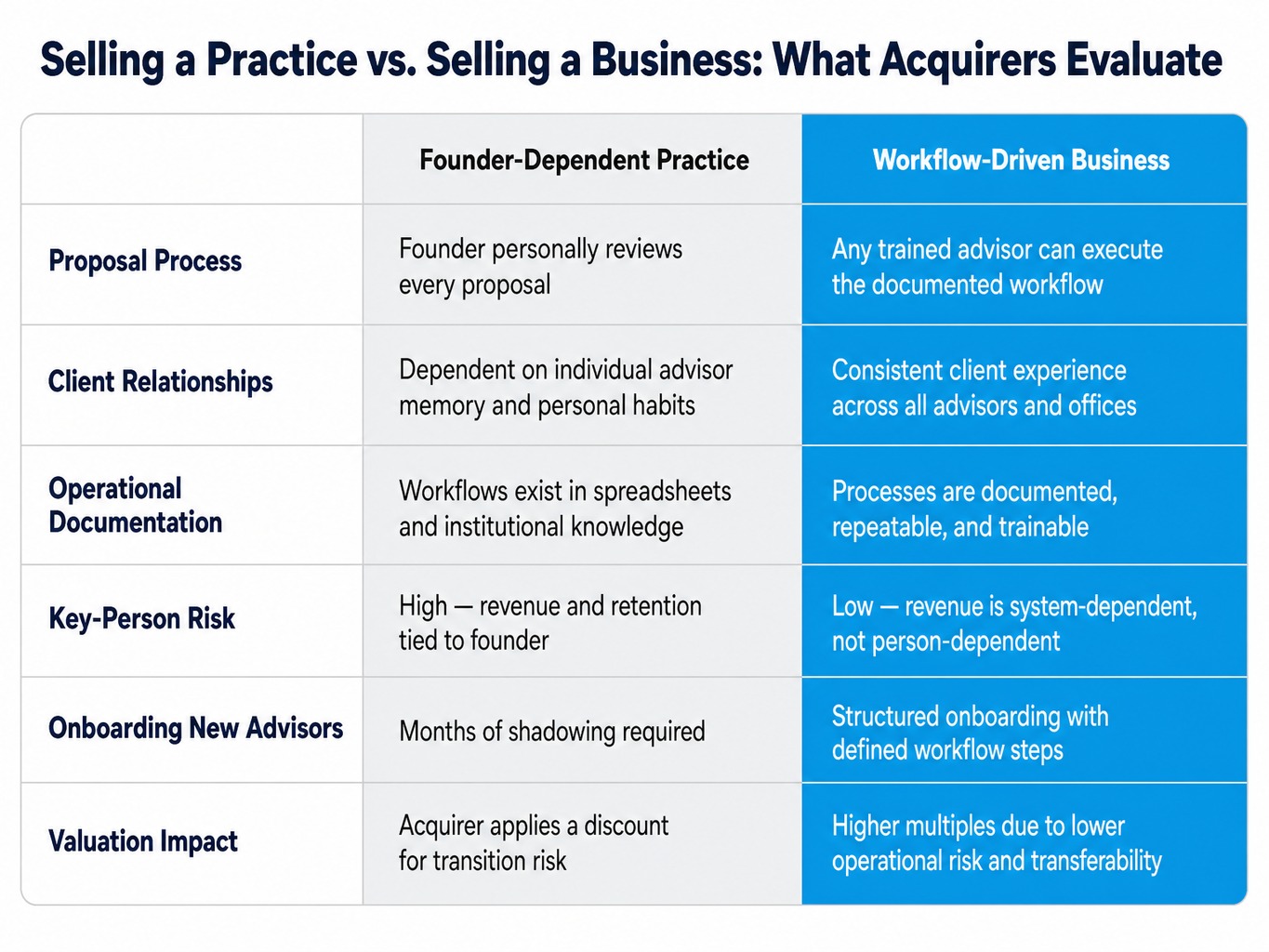
Repeatable workflows can support operational readiness for growth, succession, and transition.
How VRGL Supports the Workflow Behind Advice
One challenge firms can encounter as they scale is adding tools without designing the workflows that connect them. Critical gaps can emerge at data intake, analysis assembly, deliverable production, and governance, the areas that often consume substantial advisor and support-team time.
VRGL is designed as a configurable system of work that helps connect these steps. It supports a repeatable path from raw data to client-ready deliverables.
- For Independent Advisors: VRGL Core provides an end-to-end workflow from automated statement extraction to objective analytics to white-labeled proposals. It helps streamline manual preparation so advisors can move from statements to client-ready insights more efficiently.
- For Enterprise Firms: VRGL provides a governance layer that standardizes preparation and deliverables across teams and offices. With controlled templates, firm-wide model libraries, and permissioned workflows, firms can support consistency and oversight without dictating how advisors advise.
By structuring the work behind advice, VRGL helps firms operationalize consistency and make growth more repeatable.
See how VRGL supports repeatable advice workflows across your firm.
Conclusion
Firms looking to scale sustainably may be less defined by the volume of technology they own and more by whether they have designed a repeatable path from client data to client-ready deliverables. Effective RIA practice management is a workflow-design discipline that can support advisor capacity, firm-wide consistency, and long-term operational readiness.
By shifting focus from tool selection to workflow design, firm leaders can address common sources of inefficiency and inconsistency. They can build an operating model that governs the process without removing advisor judgment, turning operational decisions into a more deliberate approach to building capacity rather than relying only on additional headcount. As firms grow and operating models become more complex, this kind of operational discipline may be one factor that supports firms as they work to scale with greater consistency.
Frequently Asked Questions
What KPIs can an RIA track to measure practice management effectiveness?
Metrics firms may consider include preparation time per client engagement, revenue per relationship, advisor capacity utilization ratio, and proposal-to-close conversion rate. Used together, these can offer one view into how operational processes are functioning, beyond simple activity volume alone.
How can an RIA structure service tiers without over-segmenting?
Firms may choose to structure service tiers around factors such as operational complexity, number of accounts, custodians, planning needs, or client expectations. The right approach can vary by firm, and some teams may prefer simpler tiering models if more granular segmentation creates additional administrative overhead.
What is the difference between using a TAMP and managing portfolios in-house for practice efficiency?
TAMP and in-house approaches each involve tradeoffs that firms may evaluate differently. A TAMP may reduce some internal workload or shift certain responsibilities to a third party, while in-house management may offer more direct control over internal processes and portfolio decisions. The operational impact depends on the firm's service model, staffing, economics, and growth priorities.
How do you manage a multi-custodial practice without duplicating operations?
A common approach is consolidating data at the household level before analysis begins. Firms that use technology to extract and structure statement data into a single, unified view across custodians may be able to reduce one source of duplicated effort and support more complete analytics and proposals.
What practice management changes can an advisor consider before joining an RIA aggregator?
Common considerations may include documenting existing workflows, standardizing client deliverables, and understanding how portable client data and internal processes are across systems. Operational processes and key-person dependencies may be among the considerations evaluated during due diligence.
How do financial advisors automate compliance workflows without adding headcount?
Approaches to compliance workflow automation can include governed templates, version-controlled proposals, and audit trails on client-facing deliverables. Controls of this kind can help support a more structured review process while preserving necessary oversight.